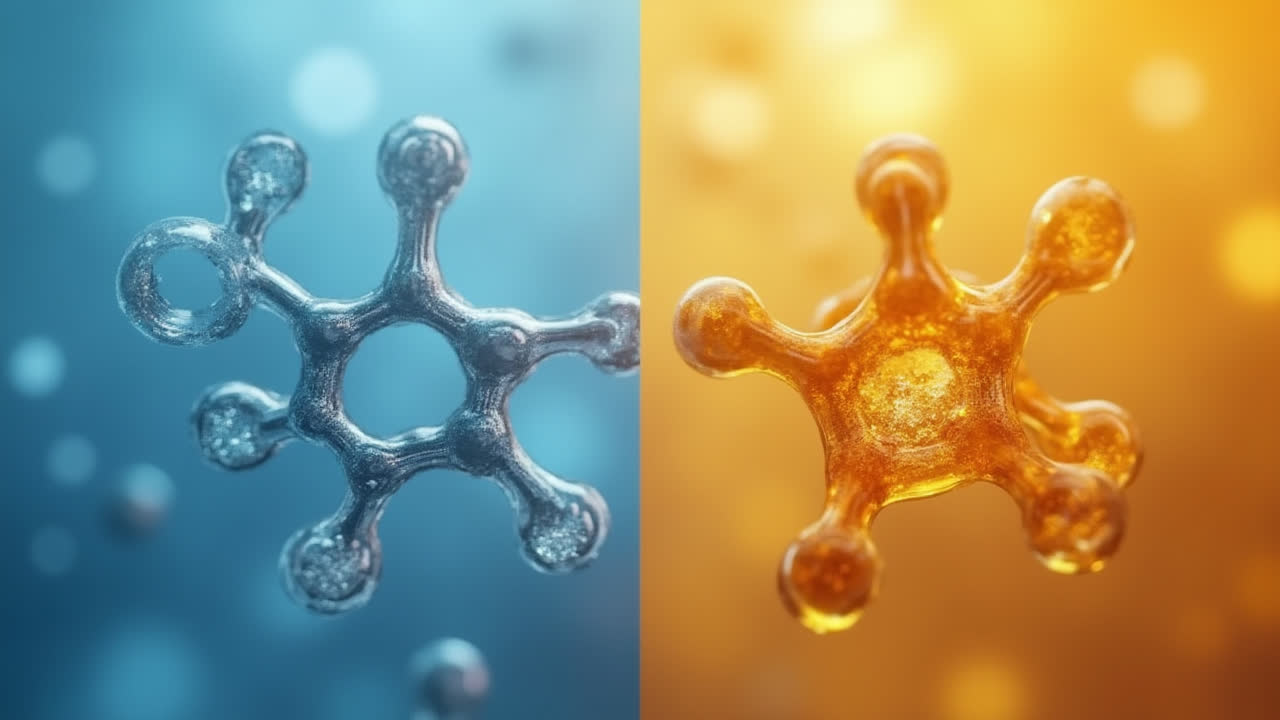
Adhesive vs Cohesive Forces: Understanding the Fundamental Differences

Adhesive vs Cohesive Forces: Understanding the Fundamental Differences
Have you ever wondered why water beads up on a freshly waxed car or how glue sticks to different surfaces? The answer lies in understanding the fascinating world of adhesive and cohesive forces. These molecular interactions shape countless phenomena in our daily lives and form the foundation for many scientific principles and technological applications.
Molecular forces might seem like abstract concepts confined to chemistry textbooks, but they're actually working all around us, every moment of every day. From the way morning dew clings to spider webs to how paint adheres to walls, these invisible forces govern much of the physical world we interact with. I've always found it remarkable how such microscopic interactions can create such visible and important effects in our world.
In this comprehensive guide, we'll explore the key differences between adhesive and cohesive forces, how they function at the molecular level, and their practical applications across various fields. Whether you're a student trying to grasp these concepts or simply curious about the forces that hold our physical world together, this article will provide clear explanations and real-world examples to enhance your understanding.
Understanding Molecular Forces: The Basics
Before diving into the specific differences between adhesive and cohesive forces, it's helpful to understand the broader context of molecular interactions. At the microscopic level, molecules are constantly interacting with one another through various types of forces. These interactions determine the physical properties of substances and how they behave in different environments.
Molecular forces range from relatively weak temporary attractions to strong chemical bonds. Van der Waals forces, hydrogen bonding, ionic interactions, and covalent bonds all play roles in how molecules relate to each other. The strength and type of these interactions affect everything from boiling points and surface tension to the ability of substances to mix or separate.
When we observe phenomena like water droplets forming on a leaf or honey sticking to a spoon, we're actually seeing the macroscopic effects of these microscopic forces in action. I remember being amazed in my first chemistry class when I realized that the same forces that make water form droplets are related to those that help geckos climb walls! Understanding these fundamental forces provides a deeper appreciation for the elegance of the natural world.
What Are Adhesive Forces?
Adhesive forces refer to the attractive forces that exist between different types of molecules or substances. When molecules of one substance are attracted to molecules of another substance, adhesion occurs. This interaction explains why some materials can stick together even when they have different chemical compositions.
One of the most common examples of adhesion is how water adheres to glass. When you fill a glass with water, you might notice that the water climbs slightly up the sides of the glass, creating a concave meniscus. This happens because the water molecules are attracted to the glass molecules more strongly than they are attracted to each other. The water molecules essentially "stick" to the glass surface due to these adhesive forces.
Adhesive forces operate through several mechanisms at the molecular level. These include hydrogen bonding (where hydrogen atoms in one molecule are attracted to electronegative atoms in different molecules), dipole-dipole interactions (attractions between oppositely charged ends of polar molecules), and London dispersion forces (temporary attractions caused by random fluctuations in electron distribution).
In many industrial applications, understanding and enhancing adhesive forces is crucial. Adhesives like glues, tapes, and epoxies work by maximizing these forces between the adhesive material and the surfaces being joined. Scientists and engineers constantly work to develop new adhesive technologies that can bond different materials more effectively, demonstrating the practical importance of these fundamental forces.
What Are Cohesive Forces?
Unlike adhesive forces, cohesive forces involve attractions between molecules of the same substance. These forces cause like molecules to stick together and maintain their structural integrity. Cohesion explains why substances retain their form rather than simply dissipating into the environment.
Water provides one of the most striking examples of cohesion in action. The strong hydrogen bonds between water molecules create significant cohesive forces, giving water its characteristic properties. These cohesive forces explain why water forms droplets on surfaces rather than spreading out completely. Each droplet represents water molecules holding tightly to one another, minimizing their surface area due to these internal attractive forces.
Beyond water, cohesive forces are evident in many other substances. Mercury forms perfect spherical droplets due to extremely strong cohesive forces between its atoms. Even solids rely on cohesive forces to maintain their shape and structure. The mechanical strength of materials like metals, ceramics, and polymers is directly related to the cohesive forces binding their constituent atoms or molecules together.
Cohesive forces play crucial roles in natural phenomena like capillary action, which enables plants to draw water up from their roots against the force of gravity. They're also fundamental to concepts like surface tension, which makes it possible for some insects to walk on water and for soap bubbles to form their perfect spherical shapes. I've spent hours as a kid blowing bubbles, never realizing I was witnessing cohesive forces at work!
Comparing Adhesive and Cohesive Forces: Key Differences
| Characteristic | Adhesive Forces | Cohesive Forces |
|---|---|---|
| Definition | Attraction between molecules of different substances | Attraction between molecules of the same substance |
| Molecular Interaction | Between unlike molecules | Between like molecules |
| Observable Effects | Materials sticking together, wetting of surfaces | Droplet formation, surface tension |
| Common Examples | Glue on paper, water on glass, paint on walls | Water droplets, mercury beads, structural integrity of solids |
| Primary Function | Joining different materials together | Maintaining a substance's internal structure |
| Responsible for | Capillary action, adhesive technologies | Surface tension, material strength |
| Related Properties | Wettability, adsorption | Viscosity, tensile strength |
| Practical Applications | Glues, tapes, coatings, printing | Liquid transport systems, surface treatments, material science |
The Interplay Between Adhesive and Cohesive Forces
While we've discussed adhesive and cohesive forces as separate concepts, it's important to understand that they often work together or in opposition to create various physical phenomena. The balance between these forces determines how substances interact with their environments and with other materials.
Consider what happens when you drop water onto different surfaces. On a waxed car surface, water beads up into nearly perfect spheres because the cohesive forces within the water are much stronger than the adhesive forces between water and the wax. The water molecules prefer to stick to each other rather than to the waxed surface. In contrast, when water is dropped onto clean glass, it spreads out because the adhesive forces between water and glass are comparable to the cohesive forces within the water itself.
This balance between adhesion and cohesion explains many everyday phenomena. It's why some fabrics are water-repellent while others absorb moisture readily. It determines whether paint will adhere properly to a surface or peel off. The design of specialized coatings, from non-stick cookware to water-repellent clothing, relies on a detailed understanding of how to manipulate these competing forces.
In my kitchen experiments, I've noticed how honey drips differently from water – the stronger cohesive forces in honey make it form much longer, more persistent strands as it pours. These simple observations reveal the complex interplay of molecular forces that scientists and engineers harness to develop new materials and technologies.
Practical Applications and Real-World Examples
In Material Science and Engineering
Engineers and materials scientists constantly leverage adhesive and cohesive forces to create new technologies and improve existing ones. Adhesives ranging from simple school glue to advanced industrial epoxies work by optimizing adhesive forces between different surfaces. The development of pressure-sensitive adhesives used in sticky notes and removable tapes involves carefully balancing adhesive forces to create a bond that's strong enough to hold but weak enough to remove without damage.
In construction and manufacturing, understanding these forces is crucial for creating durable bonds between different materials. Techniques like surface roughening or chemical treatments are often used to enhance adhesive forces between materials that wouldn't naturally bond well. Meanwhile, in materials designed to be water-repellent or non-stick, scientists work to minimize adhesive forces between the material and water or food substances.
In Biology and Medicine
Biological systems make extensive use of both adhesive and cohesive forces. Cell membranes maintain their integrity through cohesive forces between phospholipid molecules, while cell adhesion molecules enable cells to stick together to form tissues. Blood clotting relies on a complex interplay of adhesive and cohesive interactions between platelets and fibrin proteins.
In medical applications, adhesive forces are harnessed to create bandages, surgical glues, and drug delivery systems. The development of biocompatible adhesives that can work in wet, dynamic environments like the inside of the human body represents one of the more challenging frontiers in biomaterials research.
In Everyday Life
We encounter the effects of adhesive and cohesive forces constantly in our daily lives. The way water beads up on a freshly waxed car surface demonstrates strong cohesive forces winning out over weaker adhesive ones. When you use tape, you're relying on adhesive forces being stronger than the cohesive forces within the tape's adhesive layer. Even the simple act of washing your hands depends on the interplay between the adhesive forces that help soap molecules attach to dirt and oil and the cohesive forces within the water that carries it all away.
Frequently Asked Questions
How do adhesive and cohesive forces affect surface tension?
Surface tension is primarily created by cohesive forces between molecules at the surface of a liquid. These molecules are pulled inward by neighboring molecules, creating a state of tension at the surface. This is why water forms droplets rather than spreading out completely. When adhesive forces between the liquid and another surface (like glass) are stronger than the cohesive forces within the liquid, the liquid will spread out more on that surface, reducing the apparent surface tension. This explains why water forms a concave meniscus in glass tubes—the adhesive forces between water and glass pull the water up at the edges.
Can a substance exhibit both strong adhesive and strong cohesive properties?
Yes, some substances can exhibit both strong adhesive and cohesive properties. Water is a prime example—it has strong cohesive forces due to hydrogen bonding between water molecules, which gives it high surface tension. At the same time, water also demonstrates strong adhesive forces with many surfaces, especially those containing charged or polar groups. This dual nature makes water excellent at capillary action, where both adhesion to the walls of a narrow tube and cohesion within the water column work together to draw the liquid upward against gravity. Many adhesives are specifically designed to have both strong cohesive forces (to maintain their internal integrity) and strong adhesive forces (to bond well to other materials).
How do scientists measure adhesive and cohesive forces?
Scientists use various techniques to measure adhesive and cohesive forces. For cohesive forces, surface tension measurements provide insights into the strength of molecular attractions within a liquid. This can be done using methods like the du Noüy ring method, where a ring is pulled from a liquid surface and the force required is measured. Adhesive forces can be measured through contact angle measurements—where a droplet is placed on a surface and the angle between the droplet edge and the surface is measured. A smaller contact angle indicates stronger adhesion. More sophisticated techniques include atomic force microscopy, which can measure forces at the molecular level, and peel tests or lap shear tests, which measure the strength of adhesive bonds in practical applications. These measurements are crucial for developing new materials with specific adhesive or cohesive properties.
Conclusion
The distinction between adhesive and cohesive forces may seem like a technical detail, but as we've explored, these fundamental molecular interactions shape countless aspects of our physical world. From the behavior of liquids to the development of advanced materials, understanding these forces provides insight into both natural phenomena and human-made technologies.
As scientists continue to develop new materials with specialized properties, the ability to control and manipulate adhesive and cohesive forces becomes increasingly important. Whether creating super-adhesives that can bond under extreme conditions or designing surfaces that perfectly repel water, the principles we've discussed form the foundation for many innovative technologies.
The next time you observe water beading on a leaf, use glue for a craft project, or wonder at a spider web glistening with morning dew, take a moment to appreciate the invisible molecular forces at work. In these everyday examples, you're witnessing the elegant physics of adhesion and cohesion that help shape our world.