Atomic vs Crystal Structure: Key Differences You Need to Know
Atomic vs Crystal Structure: Key Differences You Need to Know
Have you ever wondered what makes matter behave the way it does? The secret lies in the atomic structure and crystal structure - two fundamental concepts that govern how molecules and compounds arrange themselves in our world. While they might sound similar, these structures are as different as comparing a single tree to an entire forest!
Understanding these structures is essential for anyone studying chemistry, physics, or materials science. It's like learning the alphabet before reading - you need to grasp these basics to comprehend more complex scientific phenomena. Let's dive into this fascinating world where atoms dance and crystals form stunning patterns.
Understanding the Fundamentals
The journey of atomic theory has been quite a rollercoaster! Once upon a time, scientists thought atoms were the smallest things possible - indivisible tiny balls that made up everything. But boy, were they in for a surprise!
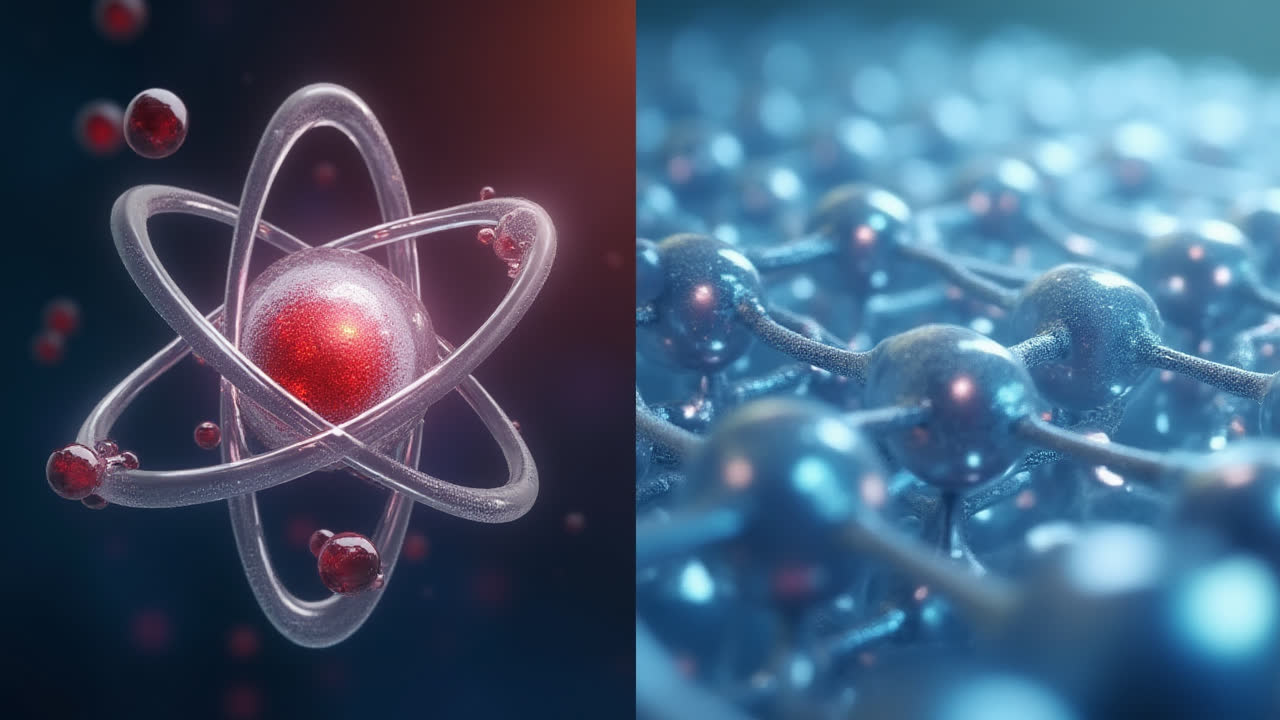
Through clever experiments and technological breakthroughs, we discovered atoms are more like incredibly tiny solar systems. They contain even smaller particles: electrons zipping around like planets, and a nucleus packed with protons and neutrons. Sometimes I think of atoms as having their own personalities - each element behaving differently based on how these particles arrange themselves.
What is Atomic Structure?
The atomic structure is essentially the blueprint of an atom. It shows how those tiny subatomic particles - electrons, protons, and neutrons - organize themselves within an atom. Think of it as the floor plan of a house, where each room has a specific purpose.
Here's the fascinating part: electrons don't just randomly float around. They move in specific areas called orbitals, arranged in shells that become more complex as you move outward from the nucleus. It's a bit like a high-rise building where the bottom floors are simpler than the penthouse level!
These electrons play a crucial role in chemical reactions - they're like the social butterflies of the atomic world, always eager to interact with other atoms. Meanwhile, protons and neutrons stay put in the nucleus, only participating in nuclear reactions.
Exploring Crystal Structure
Now, imagine taking thousands of atoms and organizing them into a beautiful, repeating pattern - welcome to the world of crystal structure! Unlike the microscopic world of atomic structure, crystal structures are visible patterns we can actually see (think diamonds, salt crystals, or snowflakes).
Crystals are like nature's architects - they build these amazing three-dimensional lattices that follow strict mathematical rules. The smallest repeating unit in this pattern is called the unit cell, and it's like a single brick in a massive building. Copy this unit cell millions of times, and voila - you've got a crystal!
There are different types of crystal structures: some look like simple cubes, others have ions arranged in specific patterns, and some even have metallic structures where electrons move freely between metal ions. It's like different architectural styles - each with its own unique beauty and purpose.
Key Differences Between the Two
The differences between atomic and crystal structures are like comparing a single note to an entire symphony. Both are essential, but they operate on completely different scales and serve distinct purposes.
| Aspect | Atomic Structure | Crystal Structure |
|---|---|---|
| Scale | Microscopic (subatomic particles) | Macroscopic (arrangements of atoms/molecules) |
| Organization | Individual atom arrangement | Collection of atoms/molecules in patterns |
| Complexity | Complex internal structure | Organized, repeating patterns |
| Components | Electrons, protons, neutrons | Atoms, molecules, ions |
| Variability | Unique to each element | Varies by compound type |
| Purpose | Chemical identity and behavior | Physical properties of materials |
| Visibility | Invisible to naked eye | Sometimes visible in large crystals |
| Stability | Generally stable | Can change with conditions |
Real-World Applications
These concepts aren't just academic curiosities - they're the foundation of countless technologies we use daily. Understanding atomic structure helps us design better semiconductors, create new medicines, and develop materials with specific properties.
Crystal structures are equally important. Want to know why diamonds are so hard? It's all about their crystal structure! Or why some metals conduct electricity better than others? Again, crystal structure plays the starring role.
The Science Behind the Structures
Getting into the nitty-gritty: electron configurations follow patterns that determine an atom's chemical personality. The Pauli exclusion principle ensures electrons don't crowd into the same space, while Hund's rules dictate how electrons fill their energy levels.
For crystals, we classify them into seven crystal systems based on their symmetry: cubic, tetragonal, orthorhombic, monoclinic, triclinic, trigonal, and hexagonal. Each system creates unique physical properties. Honestly, it's amazing how nature follows these mathematical principles so precisely!
Advanced Concepts and Modern Research
Modern technology like X-ray diffraction and electron microscopes has revolutionized our understanding of both atomic and crystal structures. Researchers are now creating artificial crystals with properties nature never dreamed of - materials that could revolutionize computing, energy storage, and even space exploration.
The field of crystallography has expanded beyond traditional minerals to include proteins, polymers, and even quasi-crystals that challenge our traditional understanding of periodic patterns. It's an exciting time to be interested in structural science!
Common Misconceptions
One common mistake is thinking atomic structure and crystal structure are interchangeable terms. They're not! Another is assuming all solids have crystal structures - many materials, like glass, are amorphous with no repeating pattern.
People often visualize atoms as tiny solar systems with electrons orbiting like planets. While this model helps us understand basic concepts, it's actually quite outdated. Modern quantum mechanics shows a much stranger, more nebulous reality where electrons exist as probability clouds!
Future Implications
As we push the boundaries of nanotechnology, our understanding of atomic and crystal structures becomes even more crucial. We're now manipulating individual atoms to create new materials with unprecedented properties.
The future might bring programmable matter that can change its crystal structure on command, or molecular machines built from perfectly arranged atomic structures. Science fiction? Maybe not for much longer!
Frequently Asked Questions
What is the relationship between atomic structure and crystal structure?
Atomic structure determines the individual building blocks (atoms), while crystal structure defines how these building blocks arrange themselves in space. It's like atoms are the letters and crystal structures are the words made from those letters.
Can you have crystal structure without atomic structure?
No, you cannot. Crystal structures are fundamentally composed of atoms arranged in specific patterns. Without atomic structure providing the basic units, crystal structure cannot exist.
Why do different elements have the same crystal structure sometimes?
Different elements can adopt the same crystal structure when their atoms have similar sizes and bonding characteristics. For example, many metals share the face-centered cubic structure because it allows for efficient packing of similarly-sized atoms.
In conclusion, understanding the difference between atomic structure and crystal structure opens up a whole new perspective on how our physical world operates. From the tiniest electron to the largest gemstone, these structures govern the properties and behaviors we observe every day. Whether you're a student just starting your scientific journey or a curious mind exploring the wonders of nature, appreciating these fundamental concepts enriches our understanding of the universe around us.